
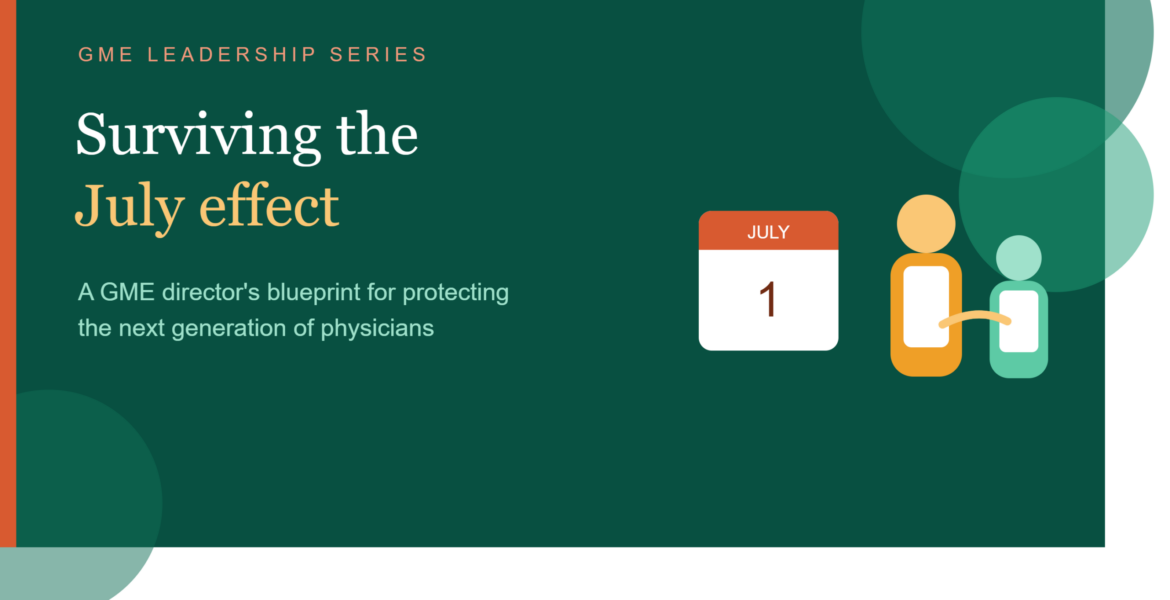
Protecting the Next Generation: A GME Director’s Blueprint for Surviving the July Effect
By Dr. Namit Choksi,
CEO of Tend Health
Every July, hospitals feel the same shift. Thousands of new doctors start residency, and the whole system braces for what we call the July Effect. It’s a well documented spike in medical errors, stress, and strain that follows every new class of residents into teaching hospitals across the country.
I’ve been on the other side of this. I remember what it felt like to carry that weight alone, a few weeks into a job that asked everything of me and gave very little back. I built Tend to change that.
For decades, medicine has treated the July Effect like a rite of passage. New residents take on 80 hour weeks, life or death decisions, and a strict hierarchy almost overnight. When the pressure becomes too much, the usual response is to tell them to build resilience.
That’s not leadership. It’s a systemic failure, and one we can fix.
The Problem With Reactive Support
Most GME programs still rely on standard Employee Assistance Programs, or EAPs, to support residents. These programs were built for a different kind of workforce. They react instead of prevent. A resident finishing a 24 hour ICU shift doesn’t need a three week wait for an out of network therapist. They need help right away.
There’s also a quieter problem. Residents learn early that asking for mental health support can feel risky. It might show up on a credentialing file. It might raise questions about their future. So many stay silent and carry the weight alone.
The cost of that silence is high, for residents and for hospitals.
When a physician leaves a program due to burnout, health systems can lose $500,000 to over $1 million in recruitment, training, and lost productivity. But the real loss is harder to measure. It’s a talented, caring doctor who walks away before their career even begins.
A Better Way Forward
At Tend, we believe in removing friction and treating physicians as whole people, not just a workforce to manage. When we do that, outcomes improve.
Fixing the July Effect starts with three things every GME Director and CMO should prioritize.
1. True Confidentiality
A mental health program only works if residents feel safe using it. Care should be separate from the hospital’s HR system, so residents can seek support without fear it will affect their credentialing or career.
2. Care That Understands Medicine
Physicians need clinicians who understand their world, not general therapists explaining unfamiliar concepts. Someone who understands the reality of a code blue, or the pressure of a surgical residency. Psychiatric care built specifically for physicians.
3. Easy, Immediate Access
Support should fit into a resident’s schedule, not the other way around. That means fast, flexible telepsychiatry that works with shift schedules, without red tape or insurance hurdles.
Building Something That Lasts
We can’t expect residents to just be more resilient inside a broken system. That’s why Tend partners with health systems and GME programs to build real support. Confidential. Built for medicine. Easy to access.
Our goal is to step in early, before burnout takes hold.
The July Effect doesn’t have to be permanent. It’s a result of how the system was built, and we can build it differently.
Is your GME program still relying on an outdated EAP?
Don’t lose great physicians to a system that wasn’t built to support them.
Schedule an Executive Consultation →
Dr. Namit Choksi is the CEO of Tend Health, a telepsychiatry and therapy provider built for healthcare professionals. He holds an MD from Maharashtra University of Health Sciences, an MPH from Harvard, and an MBA from MIT Sloan.

 We love staying connected to our community.
 Tina Runyan, PhD, ABPP